
Information Is Dead. Long Live Opinion.

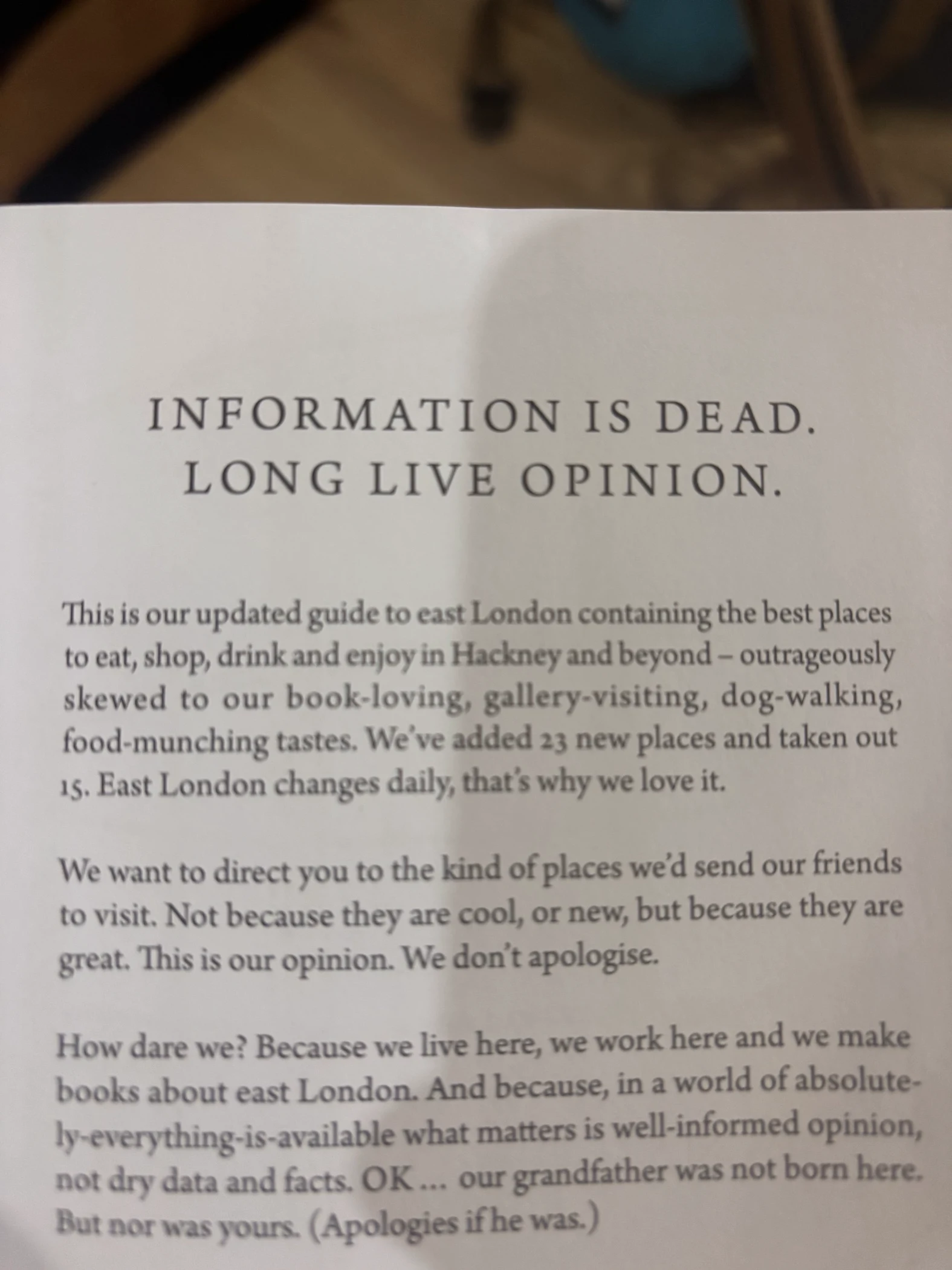
I came across a line in a book last week with a quote I loved. "Information is dead. Long live opinion." It was in a guide to east London restaurants, of all places, and the authors weren't apologising for their bias. They were leading with it. Outrageously skewed to their tastes, they said. This is our opinion. We don't apologise.
I put the book down and thought about it for a while. Because they're right. And the implications for anyone building a brand or a business in 2026 are bigger than most people are acting on.
We are drowning in information
There has never been more content available than there is right now. More articles, more guides, more frameworks, more how-tos, more listicles, more podcasts, more YouTube explainers. If you want to know how to structure a homepage, there are ten thousand free resources that will tell you. If you want to understand positioning strategy, or pricing psychology, or brand differentiation, it's all out there, indexed, searchable, instantly accessible.
And yet most businesses still can't articulate what makes them the right choice. Most founders still struggle to write a homepage headline that resonates. Most service firms still look and sound exactly like their competitors.
The information was never the missing ingredient. It was never the thing that was going to change the outcome.
What people actually want now
Here's what I think is happening. In a world where everything is available, what becomes scarce is perspective. A clear, well-argued, specific point of view from someone who has actually done the thing, worked in the space, made the mistakes, and formed an opinion from experience.
That's what the east London restaurant guide understood. Anyone can compile a list of restaurants. What you can't easily replicate is taste. Conviction. The willingness to say: this one is great, this one isn't, here's why, and we're not going to hedge.
That's what people are looking for when they follow someone on LinkedIn. Not information they couldn't find elsewhere. Opinion they couldn't easily form themselves. A perspective that either validates what they already suspected or challenges what they thought they knew.
The brands and people who are cutting through right now aren't the ones with the most content. They're the ones with the clearest point of view.
What this means for your brand
Most service business websites are information delivery systems. They tell you what the company does, how they do it, what their process looks like, and how many years they've been doing it. All information. No opinion.
There's no tension. No perspective. No sense of what this person actually believes about the work, the market, the problem, or the client. And without that, there's nothing to connect to. The prospect reads it, understands it, and forgets it. Because information without opinion is just description.
The businesses that are winning the attention battle right now, and converting that attention into clients, are the ones that have a clear position on something. They know what they believe. They know what they're against. They're willing to say "this approach doesn't work, here's why, here's what does." And that specificity, that willingness to have a view, is what makes them memorable.
The uncomfortable bit
Having an opinion means being wrong sometimes. It means someone reads your post and disagrees. It means you're not for everyone. And for a lot of founders, particularly British ones, I'd argue that's deeply uncomfortable. We're trained to hedge and to qualify, to say "it depends", to present both sides fairly and let the reader decide.
But hedging is invisible. Fairness is forgettable. The brands that people remember, recommend, and return to are almost never the ones that presented a balanced view. They're the ones that stood for something specific enough to provoke a reaction.
You don't have to be aggressive about it. You don't have to pick fights. But you do have to have a view. And you do have to be willing to put it into the world without apologising for it.
The practical upshot
Next time you write a piece of content, a homepage section, or even a LinkedIn post, ask yourself one question: is there an opinion in here, or is this just information that already exists somewhere else?
If it's just information, it's not useless. But it's not building your brand either. It's not the thing that makes someone think of you when they have a problem that matches what you do.
The thing that does that is a perspective. A take. A view that's specific enough to be yours and useful enough to be worth sharing.
Remember, information is everywhere, opinion is still rare enough to be valuable.
Subscribe to receive weekly tips, advice and knowledge on growing your business online
Before you commit to anything
Not sure where to start? The 4C Growth Diagnostic takes eight minutes.
Twenty questions. A scored breakdown across all four pillars, Clarify, Craft, Convert, Continue. You will finish with a clear view of which part of your business is holding the next stage back, a priority for where to focus first, and a free resource that addresses your specific gap directly.
There is no pitch at the end. If the output is useful, you have something to act on today. If it is not, you have lost eight minutes.